I haven’t written here in a while. Life has been full, the Substack has kept me busy, and honestly, this old blog started to feel like a room I’d stopped going into. But something happened in the news yesterday that sent me straight to the keyboard, and it didn’t belong anywhere else. So here I am.
I’ve been sitting with a story that I can’t shake.
Yesterday, the Trump Justice Department quietly settled its antitrust lawsuit against Live Nation — the company that owns Ticketmaster and controls something like 60% of the live music industry in America. This was the same case where, just days earlier in open court, internal company messages had come out showing Ticketmaster executives bragging to each other about how badly they were gouging their customers. “Robbing them blind, baby,” one wrote. “These people are so stupid. I almost feel bad for taking advantage of them.”
The settlement landed like a grenade. The federal judge overseeing the case found out about it the same way everyone else did — by email, the night before it was announced in his courtroom. The Justice Department’s own lead attorney, the man who had been trying the case for the government, told the judge under questioning that he hadn’t seen the terms of the deal until that same morning — about the same time the judge had. “You’re lead counsel for the United States, and you didn’t receive it until I did?” the judge asked. “That’s correct, your honor,” the attorney replied. The judge called it “absolute disrespect for the court, the jury, and this entire process.” The state attorneys general who had filed alongside the federal government and spent years building the case weren’t consulted either. More than two dozen of them — Republicans and Democrats both — have refused to accept the settlement and are continuing the trial on their own.
As for the deal itself, the fine amounts to about four days of the company’s annual revenue. Live Nation keeps Ticketmaster. The monopoly stands. People who just want to go to a show will keep paying whatever Ticketmaster decides to charge them, because there’s nowhere else to go.
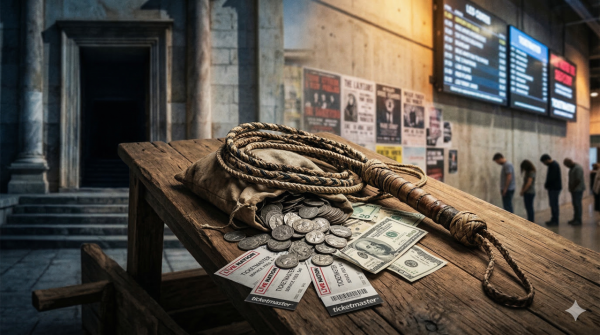
When I read all of that, I thought immediately about the money changers in the temple.
Here’s something that gets lost when we tell that story. The money changers weren’t doing something obviously wrong. They were meeting a genuine need. When Jewish pilgrims came to Jerusalem for Passover from all over the known world, they brought Roman coins, Greek coins, coins from a dozen different places — and Roman coins bore the image of Caesar, who claimed to be divine. You couldn’t use idolatrous coins to pay the temple tax. So you had to exchange them. And if you hadn’t been able to drag a goat or a sheep with you on a long journey, you had to buy your sacrifice there. The money changers and the animal sellers were, in that sense, essential parts of the whole system.
But they had a captive market. Every pilgrim had to go through them. And the high priest, who could have regulated it all and protected the poor, instead took his cut and looked the other way while the fees crept up. The people who got hurt the worst were the ones who could least afford it — the poor who could only come to offer two doves because they couldn’t afford a lamb, and who paid whatever price they were told because there was no alternative.
Jesus walked in, saw all of it, and lost his mind.
He’s quoting Jeremiah when he calls it a “den of thieves.” That matters. Jeremiah wasn’t talking about petty crime. He was standing at the temple gate telling the religious establishment that their worship had become a hollow fraud — that they thought they could spend the week grinding down the widow and the orphan and the immigrant and then show up at the temple on the Sabbath and have God be impressed. The whole passage is about powerful people using a sacred institution as cover for exploitation. Jesus looked around that courtyard and recognized exactly what Jeremiah was describing.
That is not an ancient problem.
Right now, in this country, the presidency is being used as a personal money-making operation on a scale we have honestly never seen before. The Trump family has pulled in somewhere between $800 million and several billion dollars — the estimates vary because the opacity is part of the design — largely through cryptocurrency ventures that foreign governments and corporations have bought into, apparently in hopes of purchasing favorable treatment. The founder of a crypto exchange (one that the Justice Department had found was used to launder money for drug traffickers and terrorist organizations) received a presidential pardon shortly after his company made a two billion dollar investment in the Trump family’s crypto business. An SEC fraud case against a Chinese crypto billionaire was quietly dropped after he invested $75 million in Trump’s company. Qatar gave the president a luxury jet worth $400 million, and the United States then signed what amounts to a defense guarantee protecting Qatar from military attack. American taxpayers will spend at least another $400 million retrofitting the plane. And the inspectors general — the people whose entire job is to investigate corruption inside federal agencies — were fired in a single night.
Then there’s Live Nation.
“But what’s Live Nation got to do with all that?” you might ask. The connection isn’t that Trump personally owns a piece of Ticketmaster. It’s the pattern. It’s the systematic dismantling of every mechanism designed to protect ordinary people from being gouged by concentrated power, while those at the top keep getting richer. Kellyanne Conway was lobbying for Live Nation. The company put Richard Grenell, a Trump loyalist, on its board. The antitrust chief who was actually trying the case got fired. And then the settlement came down like it was nothing, while the people who just want to take their kids to a show keep paying forty dollars in service fees on a thirty-dollar ticket because there is no other place to turn.
Who’s buying the doves here? It’s the same people it always is.
Now — and this is where I want to speak directly to people of faith, and especially to my fellow Christians.
We have a tradition that knows what this is. We have prophets who named it. We have a savior who got so angry about it that he made an actual whip out of cords and started flipping tables, and was dead within the week for his trouble. The question the church has to sit with right now isn’t whether we find this disturbing. The question is whether we are willing to do what our own tradition actually asks of us in response.
For starters, it asks us to name it plainly. Not to dress it up in careful language that leaves everybody some room to wriggle away from the truth. The church has a word for the worship of money and the exploitation of the poor. It’s called sin. Mammon is what Jesus called it, and he was clearer about its dangers than almost anything else he talked about. Part of our calling is to say plainly what we see, without hedging it into mush because it feels impolite or because we’re worried about offending someone.
It also asks us to refuse to participate. The early church’s power came partly from the fact that it built an alternative economy of mutual care that made the Roman patronage system optional for its members. Prophetic witness has never been only words — it’s been communities organized around a different set of values, money redirected, bodies standing in the way. What that looks like for each congregation, I can’t say. But I think we all have to be asking it seriously, and not settling for a vague sense of concern.
And it asks us to actually be where the price is being paid. Not in sympathy from a distance — present, in the room, at the table. With the families who have just lost food assistance. With the immigrants being stripped of legal protection. With the people who can’t afford to go to a concert, but also can’t afford the co-pay at the doctor’s office. The tradition has always put the church on the side of the dove-buyers. That’s not a comfortable place to stand, but it’s ours.
Jesus did not walk into the temple, observe what was happening thoughtfully, and write a measured response suggesting that all parties consider dialogue. He walked in and turned over the tables. And then he stayed. He stayed in Jerusalem and taught in the temple every day that week, knowing full well that the people he’d just humiliated were meeting to figure out how to kill him.
The prophets were not safe people. Jeremiah got thrown into a cistern. John the Baptist lost his head for telling the king the truth about his marriage. The writer of Revelation was exiled to a rock in the middle of the ocean. This is not a tradition that promises comfort in exchange for faithfulness. It promises something better than comfort — it promises that the arc of the universe bends toward justice, and that our voices, our communities, our presence are part of how that bending happens.
The tables are up. The money changers are doing great. The dove-buyers are paying whatever they’re told.
What does the church do now?
That’s not a rhetorical question.
 only wonder understands