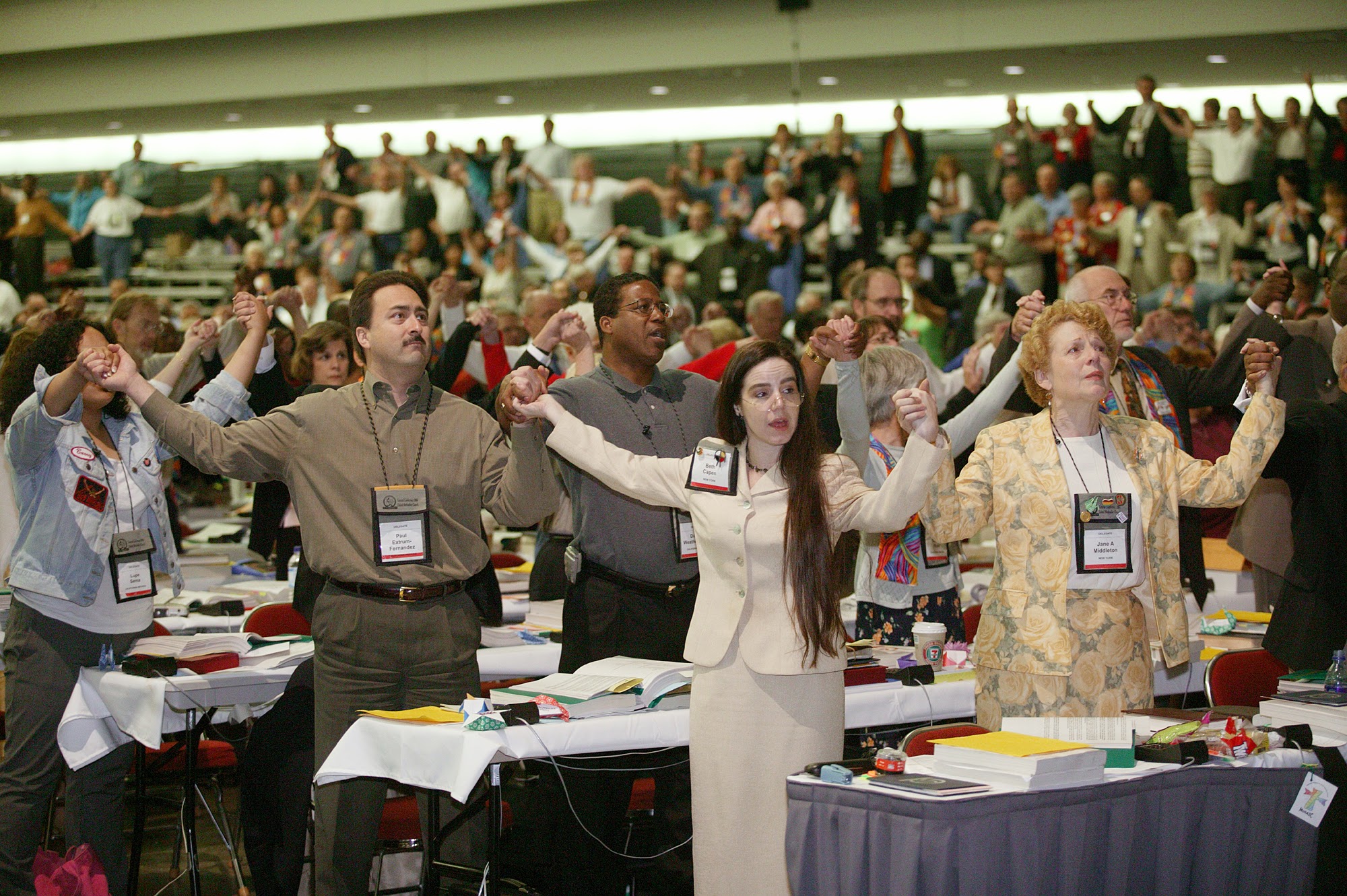
I spent more than two decades inside the United Methodist Church’s General Conference, the global gathering held every four years where the denomination makes its most consequential decisions. I started in 1988 in a technical role, managing video services, close enough to the machinery to understand how it worked. Over the next several conferences, I moved deeper in, eventually producing the plenary sessions, working with Bishop Judith Craig on the Episcopal address she delivered in 1996, and in Pittsburgh in 2004, overseeing the agenda and the electronic voting system that recorded every legislative decision. By then, I was also a pastor. I had been in my first appointment since 2000, which meant I was simultaneously trying to build the kind of community that I was watching fail on an enormous scale.
I saw the failure up close. At one conference, I watched two prominent United Methodist leaders, from opposite sides of the church’s deepening divide, in a heated argument in the shadows behind the convention hall’s back curtain while the floor session proceeded fifty feet away. They were debating whether the church should simply go ahead and split. The delegates out front were voting on legislation meant to hold it together.
In Pittsburgh, in 2004, I was part of a team that drafted a statement of unity, an attempt to articulate a common identity sturdy enough to bear the weight of the church’s divisions. The statement passed. Delegates held hands. Someone started singing. It was, for about twenty minutes, genuinely moving. And then everyone went home and ignored it. The statement wasn’t undermined or argued against. It simply had no weight outside the room where it was made. You cannot manufacture trust through a resolution, no matter how sincerely rendered in the moment. Trust lives in practice, not proclamation.
What I was watching across those years was a community that had lost faith in the possibility of genuine agreement and had replaced it with something else: the attempt to win through legislation what could no longer be achieved through relationship. Legislation is a terrible substitute for trust. Every law has a loophole. Every loophole, when exploited, confirms the suspicion that the other side was never acting in good faith, which makes the next round of legislation more adversarial, the loopholes more aggressively sought, and the trust more deeply eroded. It is a cycle with only one destination.
The United Methodist Church reached that destination in 2023, when its more conservative wing formally separated to form the Global Methodist Church. The presenting issue was human sexuality. But the real issue, the one I had watched build across more than three decades, was trust. Not the absence of conviction on either side. Both sides had plenty of that. What had run out was the willingness to assume good faith in the other, to believe that the people across the aisle were fellow pilgrims rather than adversaries to be outmaneuvered. Once that was gone, no statement of unity could put it back.
I have been thinking ever since about whether what happened in those convention halls is simply a smaller version of what is happening to us as a country.
We talk a great deal about political polarization. Scholars measure it, journalists document it, and politicians exploit it. But polarization is a symptom rather than the disease. The disease is something older and deeper: a collapse of trust so fundamental that it has begun to undermine the ground on which shared public life stands.
This is not simply about Republicans and Democrats disliking each other, though they do, at levels researchers describe as historically unprecedented. It is about the erosion of basic confidence that the people around us, even those we disagree with, are operating in good faith, inhabiting the same reality, and capable of being reasoned with. Political scientists call this affective polarization. Studies show that the partisan trust gap in America now exceeds even racial divisions in measurable terms. People extend less good faith to members of the other political party than to strangers of a different race. That is a remarkable finding, and a sobering one.
But why? Mutual dislike doesn’t fully explain it. People have always disliked their political opponents. Something has shifted in the texture of the distrust itself, something that goes deeper than any particular election or policy dispute.
I was born in 1960, which means I grew up watching institutions fail in real time. Vietnam, prosecuted on deliberate lies revealed in the Pentagon Papers. Watergate. The assassinations of King and both Kennedys. For a generation taught to trust American institutions, these events taught us that the people and systems we had relied on to tell us the truth were capable of sustained, consequential lying.
Those failures produced two very different responses. The first was prophetic: hold these institutions accountable and demand they become what they claim to be. The civil rights movement embodied this response. It didn’t reject American institutions. It demanded that America live up to the promises inscribed in its founding documents.
The second response was therapeutic and individualist: these institutions have failed me, therefore I will trust no institution and I will be my own authority. The sociologist Philip Rieff had seen this coming as early as 1966, when he wrote that Western culture was shifting away from shared moral frameworks and toward the individual’s own psychological well-being as the supreme value. He called it the triumph of the therapeutic, and he worried that without some commitment higher than the self, culture would grow increasingly fragmented, with nothing acting as glue to hold it together. What we lost was not simply a set of institutions. We lost the practice of submitting ourselves to something larger than our own judgment.
Harvard political scientist Robert Putnam documented those consequences in Bowling Alone, tracking the decline of social capital across America from the late 1960s onward. Americans were joining fewer organizations, knowing their neighbors less, and trusting strangers less. More people were bowling than ever before, but fewer were bowling in leagues. The image is almost comic, but the reality it points to is not. The ordinary infrastructure of civic life, the regular encounter with people unlike yourself inside a shared practice, was quietly disappearing. And that infrastructure is precisely where trust gets built. You trust your neighbor not because you have evaluated their character in the abstract, but because you have served on the same committee, disagreed about the same budget, and shown up together anyway.
When that infrastructure erodes, something dangerous becomes possible. A population that has lost its communal habits, that has been told its own judgment is the only reliable authority, and that has legitimate grievances against institutions that did genuinely fail them becomes vulnerable to political entrepreneurs who make their living in distrust. The deliberate cultivation of the idea that every institution, every expert, and every news source other than the one you are currently consuming is lying to you did not create the trust crisis. But it poured gasoline on conditions that already existed.
Hannah Arendt, writing in the early 1970s in response to the deceptions surrounding the Vietnam War, understood what was at stake better than almost anyone. When political leaders systematically substitute lies for facts, she argued, the result is not simply that lies are believed and truth discredited. The deeper damage is to the shared sense of a common reality that makes political life possible at all. We need institutions like courts, universities, and a free press to say what is, to confirm the ground on which we stand. When those institutions are delegitimized, we do not merely disagree about politics. We stop inhabiting the same world.
That is where we are now. The challenge is not simply that our leaders lie. Leaders have always lied. The challenge is that lying has become so normalized, so ambient, that many people have abandoned the expectation of truth from public life altogether. When you stop expecting truth, you stop being able to extend trust, not because you are irrational, but because you are paying attention.
The crisis of trust is not, at its deepest level, a political problem. It is a spiritual one, and I mean that in the most precise sense, not the vaguest.
All of us are trusting creatures. We trust before we know. We believe before we can prove. Every system of knowledge rests on a foundation of prior trust that cannot itself be fully justified by the system it supports. The scientist trusts that the external world is real and knowable, that other researchers are reporting their findings honestly, and that the instruments are reliable. She cannot prove these things from within science. She has to assume them in order to do science at all. The philosopher Ludwig Wittgenstein called these bedrock commitments hinge propositions, the things we stand on before we can stand anywhere else.
What this means is that the question is never whether to trust, but what, and whom, to trust, and on what basis. I have chosen to ground my life in a religious tradition centered on the teachings of Jesus and a belief in a God who regards every human being as sacred. Others ground their lives in science and empirical experience, or in family, or in some other framework of meaning. None of these commitments is purely rational in the sense of being derivable from first principles without any prior act of faith. All of them require a fundamental decision, often made below the level of conscious reasoning, about what you are going to stand on.
The crisis of our moment is not that people trust the wrong things. It is that we have largely lost the capacity to acknowledge that we trust anything at all, that we stand on ground we did not lay, and that the person across the aisle is, like us, a trusting creature doing their imperfect best to orient themselves in a bewildering world.
That acknowledgment, call it epistemic humility or just honesty, is the necessary precondition for any real conversation across difference. Not agreement. Not the surrender of conviction. Just the recognition that you and I are both, finally, creatures of faith, and that this makes us more alike than our politics suggest.
I don’t have a program for how to get there from here. Anyone who tells you they do is probably selling something. The path back from where we are is long, and it runs through the hard, unglamorous work of rebuilding the practices that make trust possible, not because we feel warmly toward one another, but because we commit to showing up together anyway, over time, inside structures that hold us accountable to something beyond our own preferences.
The church is supposed to be one of those structures. Not a sanctuary from the world’s divisions, but a community formed by practices that make genuine encounter possible: common prayer, common table, common service to the neighbor, and the disciplined presence with people we did not choose, sustained through conflict and disagreement, without the easy exit that our therapeutic culture always makes available. John Wesley understood this. The class meeting, the small and accountable weekly gathering at the heart of early Methodism, was not a support group where you shared your feelings. It was a community of practice where you examined your life against a shared moral framework and reported honestly to one another. The goal was not warmth. It was formation.
What we need, in the end, is not a political program or even a spiritual technique. We need something closer to what the Greek New Testament calls metanoia, a transformation so fundamental that it changes what you see when you look at the world and the people in it. The recognition that we are not self-sufficient individuals who arrived at our convictions through pure reason, but dependent, trusting, and fragile creatures, bound to one another whether we like it or not. The person you have decided is your enemy made their first act of trust before they were old enough to reason, just as you did. That shared vulnerability, that common condition of creatures who must trust in order to live, is somewhere the beginning of something.
I watch my three small congregations in central Vermont show up for one another week after week, through illness, loss, disagreement, and the ordinary frictions of community life, and I think: this is not nothing. This is, in fact, the thing itself. Not a solution to the country’s crisis of trust, but a practice of the alternative. A small, imperfect, and stubbornly persistent refusal to bowl alone.
I don’t know exactly what comes after that beginning. But I know we cannot get there without it.
 only wonder understands